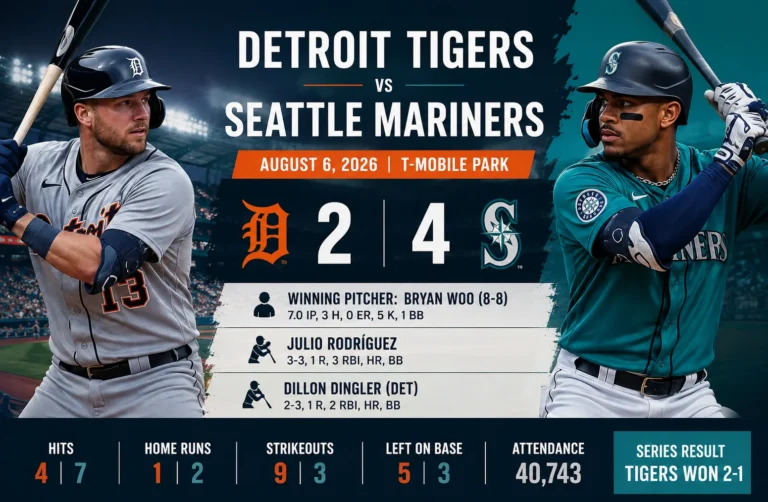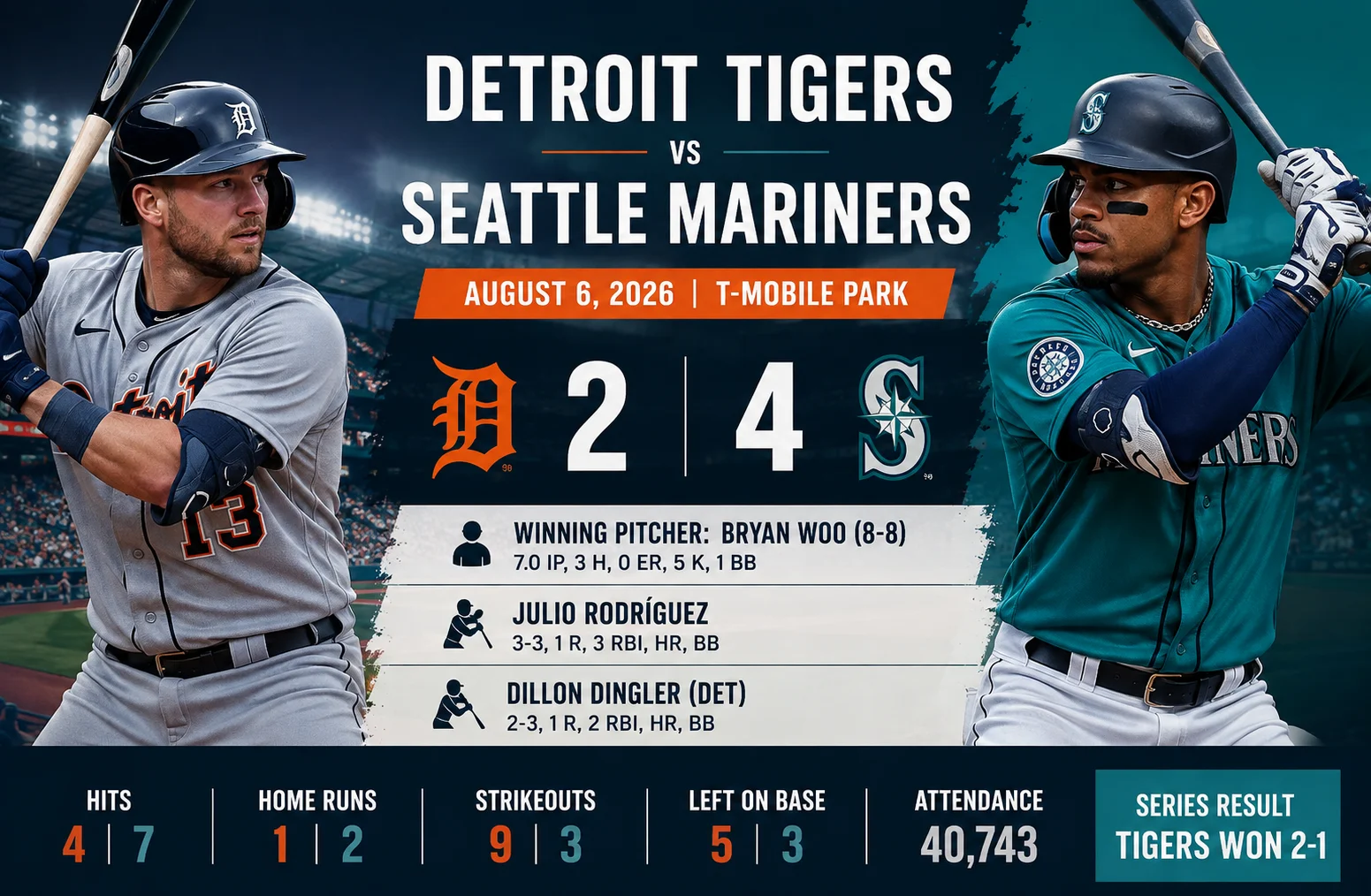
The Detroit Tigers vs Seattle Mariners match player stats from August 6, 2026, provide a much deeper look at the game than the final 4-2 score suggests. The Seattle Mariners defeated the Detroit Tigers at T-Mobile Park, but the contest remained competitive for much of the afternoon.
Seattle finished with seven hits and scored all four of its runs through two home runs. Julio Rodríguez delivered the biggest offensive moment with a three-run homer, while Cole Emerson added a solo shot later in the game. Detroit answered in the eighth inning when Dillon Dingler launched a two-run home run.
The pitching performance was equally important. Bryan Woo worked seven scoreless innings for Seattle, allowing only three hits while striking out five. Andrés Muñoz then handled the ninth inning and recorded his 20th save.
The result was also part of a three-game series that Detroit ultimately won 2-1. The Tigers opened the series with an 8-0 victory and closed it with an 11-0 shutout, while Seattle claimed the middle game 4-2.
This detailed breakdown looks at the Detroit Tigers vs Seattle Mariners match player stats, important batting and pitching numbers, scoring plays, situational hitting, and the wider series context.
Detroit Tigers vs Seattle Mariners Match Player Stats: Game Overview
The August 6 matchup was played at T-Mobile Park in Seattle, Washington. The Mariners entered the game with a 56-59 record and were 33-25 at home. Detroit came into the contest at 55-59 overall and 25-32 on the road.
Seattle eventually secured a 4-2 victory.
The game lasted 2 hours and 21 minutes and was watched by 40,743 fans.
Basic Team Statistics
| Category | Detroit Tigers | Seattle Mariners |
|---|---|---|
| Final score | 2 | 4 |
| At-bats | 29 | 28 |
| Runs | 2 | 4 |
| Hits | 4 | 7 |
| RBI | 2 | 4 |
| Home runs | 1 | 2 |
| Walks | 1 | 2 |
| Strikeouts | 9 | 3 |
| RISP | 0-for-3 | 1-for-3 |
| Left on base | 5 | 3 |
| Double plays | 3 | 1 |
The most obvious offensive difference was Seattle’s seven hits compared with Detroit’s four. However, the pitching numbers provide an even clearer explanation of the result.
Seattle’s pitchers gave up four hits and two earned runs. Detroit’s pitching staff surrendered seven hits and four earned runs. Seattle also finished with nine strikeouts, while Detroit pitchers recorded three.
Those numbers show how Seattle combined pitching efficiency with timely power hitting.
Bryan Woo Controls the Game for Seattle
Bryan Woo was one of the most important players in the matchup.
Woo completed seven innings and allowed three hits without giving up an earned run. He walked one batter and struck out five. The victory moved his record to 8-8.
Bryan Woo’s Pitching Line
| Statistic | Bryan Woo |
|---|---|
| Innings | 7.0 |
| Hits allowed | 3 |
| Earned runs | 0 |
| Walks | 1 |
| Strikeouts | 5 |
| Decision | Win |
| Record | 8-8 |
The most significant part of Woo’s performance was the combination of workload and run prevention. Seven innings without an earned run gave Seattle’s offense plenty of time to establish an advantage.
Detroit did manage to collect three hits against Woo, but those hits did not turn into earned runs. That was particularly important because the Tigers eventually found some success against the Mariners’ bullpen.
Woo therefore gave Seattle a strong foundation before the late innings.
Why Woo’s Seven Scoreless Innings Mattered
Detroit was not completely without offensive opportunities. The Tigers eventually finished with four hits and two runs.
However, those runs came after Woo had already completed his outing.
That distinction is important when examining the Detroit Tigers vs Seattle Mariners match player stats. A starting pitcher who can work seven innings while keeping the opposition off the scoreboard reduces pressure on the bullpen and gives his team more room to manage the final two innings.
Woo’s outing accomplished exactly that.
Julio Rodríguez Produces the Key Offensive Moment
Julio Rodríguez supplied Seattle’s biggest offensive contribution.
He finished with two hits in three at-bats, scored once, drove in three runs, hit a home run, and drew a walk. He also avoided a strikeout.
Julio Rodríguez’s Statistics
| Statistic | Julio Rodríguez |
|---|---|
| At-bats | 3 |
| Hits | 2 |
| Runs | 1 |
| RBI | 3 |
| Home runs | 1 |
| Walks | 1 |
| Strikeouts | 0 |
Rodríguez’s biggest contribution came in the sixth inning.
He hit a three-run home run that brought home himself, Randy Arozarena, and Dominic Canzone. The home run traveled 366 feet and was his 17th of the season.
The blast accounted for three of Seattle’s four total runs.
That made it the most important scoring play of the game.
Rodríguez’s Efficient Offensive Performance
Rodríguez did not need many plate appearances to make a major contribution.
He reached base through two hits and a walk and did not strike out. More importantly, one of his hits produced three runs.
Seattle did not need a long sequence of singles and doubles to build its lead. Rodríguez converted an important opportunity into a three-run homer.
That is one of the clearest examples of why raw hit totals do not always explain how a baseball game is decided.
Dillon Dingler Gives Detroit a Late Lift
Dillon Dingler was Detroit’s leading offensive contributor.
He finished 2-for-3 with one run, two RBI, one home run, one walk, and one strikeout.
Dillon Dingler’s Numbers
| Statistic | Dillon Dingler |
|---|---|
| At-bats | 3 |
| Hits | 2 |
| Runs | 1 |
| RBI | 2 |
| Home runs | 1 |
| Walks | 1 |
| Strikeouts | 1 |
Dingler’s most important moment came in the eighth inning.
He launched a two-run home run that traveled 424 feet. It was his 25th home run of the season.
The blast brought Detroit back into the contest and reduced Seattle’s advantage.
Both of Detroit’s runs came from Dingler’s home run, which shows how much impact one swing can have.
Even though the Tigers lost, Dingler produced a significant individual performance.
Cole Emerson Restores Seattle’s Lead
Seattle responded quickly after Detroit’s eighth-inning home run.
Cole Emerson hit a solo home run in the same inning, giving the Mariners another two-run cushion.
Emerson finished 1-for-3 with one run and one RBI.
Cole Emerson’s Line
| Statistic | Cole Emerson |
|---|---|
| At-bats | 3 |
| Hits | 1 |
| Runs | 1 |
| RBI | 1 |
| Home runs | 1 |
Emerson’s home run was his eighth of the season and traveled 423 feet.
The timing made the hit particularly important.
Detroit had just created momentum with Dingler’s two-run blast. Emerson immediately answered with another home run, preventing the Tigers from carrying that momentum into the ninth inning.
As a result, Seattle entered the final inning with a two-run lead instead of a much narrower advantage.
Randy Arozarena Adds Two Hits
Randy Arozarena also contributed to Seattle’s offensive production.
He went 2-for-4 and scored once, although he did not record an RBI.
His contribution becomes more meaningful when viewed alongside the sixth-inning scoring sequence. Arozarena scored on Rodríguez’s three-run homer.
His two hits also helped Seattle reach seven total hits.
This illustrates why player statistics are best considered within the context of individual innings. A hitter does not necessarily need an RBI to have played an important role in a scoring sequence.
Detroit’s Offensive Challenges
One of the biggest statistical issues for Detroit was its inability to capitalize on runners in scoring position.
The Tigers went 0-for-3 with runners in scoring position.
Seattle, by comparison, went 1-for-3.
The opportunity count was not especially large, but Detroit’s lack of success in those situations mattered because the Tigers also left five runners on base.
Detroit finished with only four hits and struck out nine times.
Detroit’s Key Offensive Numbers
- 4 total hits
- 9 strikeouts
- 0-for-3 with runners in scoring position
- 5 runners left on base
- 1 home run
Despite those limitations, Detroit scored twice through Dingler’s eighth-inning home run.
Detroit’s Home Run Supplied All of Its Runs
Dingler’s two-run homer accounted for both Detroit runs.
That meant the Tigers did not build their scoring through several separate offensive sequences. Instead, their entire scoring output came from one high-impact swing.
This is a useful distinction when studying the Detroit Tigers vs Seattle Mariners match player stats.
A team can collect multiple hits without producing many runs, while another team can score quickly through one well-timed home run.
Detroit experienced the latter situation.
Seattle’s Offense Converts Its Opportunities
Seattle finished with seven hits, three more than Detroit.
The Mariners also hit two home runs compared with one for the Tigers.
More importantly, both Seattle home runs directly produced its four runs.
Rodríguez hit the three-run homer in the sixth inning, while Emerson supplied the solo homer in the eighth.
So Seattle’s offense did not require a constant stream of baserunners to score.
Instead, two major swings produced all four runs.
That is a major feature of this matchup.
Seattle generated more hits overall and converted its most important opportunities into runs.
The Sixth Inning Becomes the Turning Point
The sixth inning changed the direction of the game.
Before Rodríguez’s home run, the contest remained within reach for both teams.
Then Rodríguez launched his three-run shot, scoring himself, Arozarena, and Canzone.
Seattle suddenly had a three-run advantage.
The value of the home run went beyond its three RBI. It also changed the situation for both teams.
Detroit now had to produce multiple successful offensive plays to catch up, while Seattle could concentrate on protecting its lead.
That is why timing matters when analyzing baseball statistics.
A player’s total number of hits may tell only part of the story. The inning, score, baserunners, and game situation provide additional context.
The Eighth Inning Brings the Late Drama
The eighth inning delivered the game’s second major scoring sequence.
Dingler hit his 25th home run, a 424-foot shot that brought Detroit back into contention.
For a moment, Seattle’s advantage was under pressure.
But Emerson responded with a 423-foot solo home run.
The Mariners immediately restored their two-run lead.
This sequence shows how quickly a late-inning baseball game can change.
Detroit finally produced significant offense after Woo had left the game, but Seattle answered before the Tigers could turn that momentum into a full comeback.
From a game-analysis standpoint, Emerson’s home run was an important insurance run.
Detroit Pitching and the Home Run Problem
Detroit’s pitching staff had a more difficult night than Seattle’s.
The Tigers allowed seven hits and four earned runs over eight innings. They issued two walks and recorded three strikeouts.
Detroit Pitching Statistics
| Statistic | Detroit Pitching |
|---|---|
| Innings | 8.0 |
| Hits allowed | 7 |
| Runs allowed | 4 |
| Earned runs | 4 |
| Walks | 2 |
| Strikeouts | 3 |
| Home runs allowed | 2 |
The most damaging statistic was the two home runs allowed.
Seattle did not overwhelm Detroit with constant offensive pressure. Instead, the Mariners took advantage of important opportunities with power.
Rodríguez’s three-run homer created the game’s initial separation, while Emerson’s eighth-inning home run stopped Detroit from making the game even tighter.
Beau Brieske Hanifee’s Difficult Appearance
The loss was charged to B. Hanifee.
He recorded 0.0 innings while allowing two hits, three earned runs, and one walk. The decision moved his record to 0-1.
His appearance occurred during an important part of the game.
The combination of hits and the walk contributed to Seattle’s scoring advantage.
Relief appearances can have a major influence on a game even when the pitcher is on the mound for only a short time. Situations involving runners on base can make a few pitches especially important.
Andrés Muñoz Finishes the Game
Seattle’s closer Andrés Muñoz handled the ninth inning and recorded his 20th save.
Andrés Muñoz’s Final Line
| Statistic | Andrés Muñoz |
|---|---|
| Innings | 1.0 |
| Hits allowed | 0 |
| Earned runs | 0 |
| Walks | 0 |
| Strikeouts | 2 |
| Saves | 20 |
Muñoz allowed no hits and no walks while striking out two batters.
That gave Detroit no opportunity to extend the game after Emerson’s home run had restored Seattle’s two-run advantage.
For Seattle, the ninth inning was about protecting the lead without putting additional runners on base.
Muñoz completed that task with a clean inning.
Team Pitching Comparison
The pitching statistics provide a clear picture of the difference between the two teams.
| Category | Tigers | Mariners |
|---|---|---|
| Innings | 8.0 | 9.0 |
| Hits allowed | 7 | 4 |
| Runs allowed | 4 | 2 |
| Earned runs allowed | 4 | 2 |
| Walks | 2 | 1 |
| Strikeouts | 3 | 9 |
| Home runs allowed | 2 | 1 |
Seattle allowed three fewer hits and recorded six more strikeouts.
The Mariners also gave up only one walk.
Those numbers helped keep Detroit’s offense to two runs.
Detroit’s pitchers did not give up an enormous number of baserunners, but Seattle’s ability to produce runs through home runs made the difference.
Double Plays and Defensive Value
Detroit turned three double plays during the game, while Seattle turned one.
Double plays can be especially valuable because they eliminate baserunners and end innings quickly.
Detroit’s three double plays therefore represented an important defensive contribution.
However, those plays could not completely offset Seattle’s timely power hitting.
The game provides a useful reminder that one statistical strength does not necessarily overcome weaknesses in another area.
Detroit’s defense helped prevent longer innings, but Seattle’s home runs produced enough runs to secure the victory.
Runners in Scoring Position
The Tigers finished 0-for-3 with runners in scoring position.
Seattle went 1-for-3.
Neither team had a large number of opportunities in this category, but the difference still mattered.
Detroit’s inability to record a hit in those situations meant the team relied heavily on Dingler’s home run for its scoring.
Seattle also depended heavily on power, but Rodríguez’s three-run home run came at a particularly important point in the game.
The RISP numbers therefore show that neither team produced a sustained situational-hitting attack.
The biggest difference was the timing of Seattle’s most important hit.
Leading Hitters Compared
Julio Rodríguez and Dillon Dingler were the clearest offensive contributors for their respective teams.
| Category | Julio Rodríguez | Dillon Dingler |
|---|---|---|
| At-bats | 3 | 3 |
| Hits | 2 | 2 |
| Runs | 1 | 1 |
| RBI | 3 | 2 |
| Home runs | 1 | 1 |
| Walks | 1 | 1 |
| Strikeouts | 0 | 1 |
Both players reached base three times through two hits and one walk.
Both hit home runs.
Both scored once.
The difference came in RBI production. Rodríguez’s home run drove in three runs, while Dingler’s home run drove in two.
Dingler was Detroit’s main offensive contributor, while Rodríguez’s production provided Seattle with the larger scoring contribution.
Why the 4-2 Score Needs More Context
A 4-2 final score might initially suggest a comfortable Seattle victory.
The underlying statistics tell a more balanced story.
Detroit finished with four hits compared with Seattle’s seven. The Tigers also turned three double plays and scored twice in the eighth inning.
The game therefore was not simply a case of Seattle controlling every aspect from beginning to end.
The main difference was how the teams converted their opportunities.
Seattle turned seven hits into four runs.
Detroit turned four hits into two runs.
Both teams relied heavily on home runs for their scoring.
Seattle’s two home runs produced all four of its runs, while Detroit’s one home run produced both of its runs.
The final difference therefore came largely from timely power hitting combined with Seattle’s pitching performance.
Series Context
The August 6 game should also be considered as part of the complete three-game series.
Detroit ultimately won the series 2-1.
Series Results
- Game 1: Detroit Tigers 8, Seattle Mariners 0
- Game 2: Seattle Mariners 4, Detroit Tigers 2
- Game 3: Detroit Tigers 11, Seattle Mariners 0
The series context changes how the individual game should be viewed.
Seattle won the middle game, but Detroit won the overall series.
The Tigers also scored 19 runs across Games 1 and 3 while allowing Seattle no runs in those two games.
Therefore, the Mariners’ 4-2 victory represents one game in a series that Detroit ultimately won 2-1.
What the Player Statistics Tell Us
The most useful way to understand baseball statistics is to connect the numbers with the situations in which they occurred.
Several lessons stand out from this matchup.
1. Seven Scoreless Innings Can Shape an Entire Game
Bryan Woo’s seven scoreless innings prevented Detroit from establishing an early lead.
His ability to limit the Tigers to three hits and no earned runs gave Seattle a strong platform.
2. One Big Swing Can Change the Score Quickly
Julio Rodríguez’s three-run homer produced three of Seattle’s four runs.
The hit demonstrates how one well-timed home run can have a larger effect on a game than several smaller offensive contributions.
3. Insurance Runs Matter Late in Games
Cole Emerson’s eighth-inning home run came immediately after Detroit had reduced Seattle’s advantage.
The homer restored the two-run cushion and gave Muñoz additional room to work with in the ninth.
4. A Losing Team Can Still Produce a Strong Individual Performance
Dillon Dingler had two hits, a walk, two RBI, and a 424-foot home run.
Although Detroit lost, Dingler was responsible for both of the team’s runs.
5. Situational Hitting Can Influence the Final Result
Detroit went 0-for-3 with runners in scoring position.
When opportunities are limited, converting even one additional situation can potentially change the scoring pattern of a close game.
How to Analyze Baseball Player Stats
When comparing MLB box scores, looking only at batting average or total hits does not provide the complete picture.
A more useful approach is to examine several categories together.
Offensive Production
Look at:
- Hits
- Home runs
- RBI
- Runs
- Walks
- Strikeouts
These numbers help explain how often players reached base and how directly they contributed to scoring.
Pitching Quality
Important pitching categories include:
- Innings pitched
- Hits allowed
- Earned runs
- Walks
- Strikeouts
- Home runs allowed
Innings and earned runs are particularly useful for evaluating how effectively a starting pitcher kept the opposition from scoring.
Situational Performance
Also examine:
- Runners in scoring position
- Runners left on base
- Late-inning production
- Runs by inning
These details provide additional information about how teams converted opportunities.
Game-Changing Plays
Identify the moments that significantly changed the game.
In this matchup, Rodríguez’s three-run home run and Emerson’s eighth-inning home run were major Seattle scoring events.
For Detroit, Dingler’s two-run homer was the most important offensive response.
Series Context
A single game should not always be viewed independently.
The Tigers’ 2-1 series victory demonstrates why the broader series results provide useful context when assessing one individual matchup.
Frequently Asked Questions
Who won the Detroit Tigers vs Seattle Mariners game on August 6, 2026?
The Seattle Mariners defeated the Detroit Tigers 4-2 at T-Mobile Park in Seattle.
Who was Seattle’s leading hitter?
Julio Rodríguez was Seattle’s leading offensive contributor. He finished 2-for-3 with one run, three RBI, one home run, and one walk.
Who led the Tigers offensively?
Dillon Dingler led Detroit’s offense. He went 2-for-3 with one run, two RBI, one home run, and one walk.
Who was the winning pitcher?
Bryan Woo earned the win after pitching seven innings. He allowed three hits and no earned runs while striking out five.
Who recorded the save?
Andrés Muñoz recorded his 20th save. He pitched one scoreless inning, allowed no hits or walks, and struck out two.
Did the Tigers win the series?
Yes. Detroit lost the August 6 game 4-2 but won the three-game series 2-1.
Conclusion
The Detroit Tigers vs Seattle Mariners match player stats show that Seattle’s 4-2 victory was based on a combination of effective starting pitching, timely home runs, and late-game execution.
Bryan Woo established the foundation by throwing seven scoreless innings and limiting Detroit to three hits. Julio Rodríguez then provided the game’s biggest offensive moment with a three-run home run in the sixth inning.
Detroit did not go quietly.
Dillon Dingler hit a two-run, 424-foot home run in the eighth inning, giving the Tigers an opportunity to make the game much closer. Seattle responded immediately when Cole Emerson hit a solo home run, restoring the Mariners’ two-run advantage.
Andrés Muñoz then closed the game with a scoreless ninth inning and two strikeouts.
The team statistics reinforce the final result. Seattle recorded seven hits compared with Detroit’s four and struck out nine while allowing only one walk. Detroit, meanwhile, struck out three times as many batters and finished 0-for-3 with runners in scoring position.
At the same time, the larger series picture is important. Detroit won Games 1 and 3 by scores of 8-0 and 11-0, respectively, while Seattle claimed the middle game 4-2.
That means the August 6 result was a single-game Seattle victory inside a series ultimately won 2-1 by Detroit.
For readers studying the Detroit Tigers vs Seattle Mariners match player stats, the biggest lesson is that a box score becomes more useful when individual numbers are connected to timing and game situation. Hits, home runs, pitching innings, strikeouts, runners in scoring position, and late-inning plays all help explain not just what happened, but how the final score developed.
About the Author